
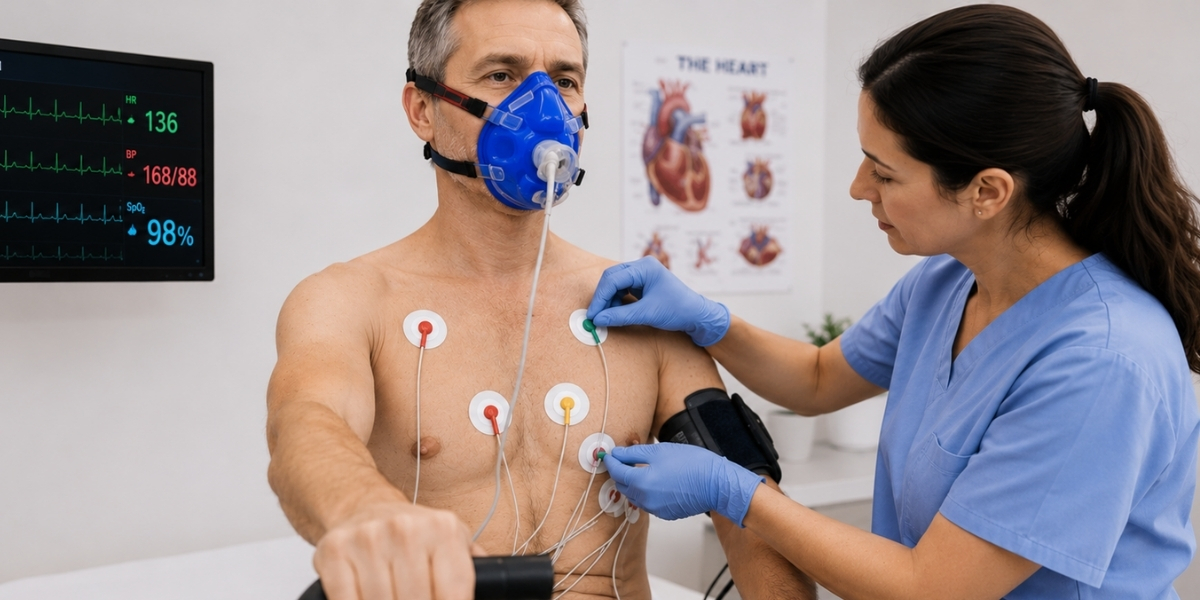
Some heart problems only reveal themselves when the heart is working hard. At rest, everything can look fine but during exertion, the difference between a healthy heart and one that isn’t getting enough blood can become clear. A stress echocardiogram is designed to catch exactly that. By imaging your heart both at rest and under stress, it gives your cardiologist a dynamic picture of how well your heart muscle is performing.
For patients across Brisbane’s bayside and eastern suburbs, from Cannon Hill and Murarrie to Manly and Cleveland, BK Heart in Alexandra Hills offers stress echocardiography as part of its diagnostic cardiac services. This guide explains what the test involves, why it might be recommended, and what you can expect on the day.
A stress echocardiogram often shortened to “stress echo” combines two things: an ultrasound scan of the heart (an echocardiogram) and a controlled period of stress, usually exercise. The ultrasound uses sound waves to create moving images of your heart’s chambers, valves, and walls. By comparing these images before and after your heart is made to work harder, your cardiologist can see how the heart muscle responds.
The key idea is straightforward. When the heart works harder, it needs more blood supply. If a coronary artery is significantly narrowed, the affected part of the heart muscle may not contract as well under stress as it does at rest. A stress echo can reveal these changes, which might not be visible on a resting test alone.
Because it uses ultrasound rather than X-rays, a stress echocardiogram involves no radiation. You can see how it sits alongside the clinic’s other tests on the BK Heart diagnostic services page.
Your cardiologist may recommend a stress echocardiogram for several reasons, including:
The Cardiac Society of Australia and New Zealand and broader cardiology practice recognise stress echocardiography as a well-established, non-invasive method for assessing the heart under load. As a functional test, it complements anatomical imaging such as cardiac CT, one shows the structure of the arteries, while the other shows how the heart performs when challenged. In some patients, both are used together to build a complete picture.
At BK Heart, stress echocardiography is one of Dr Neelabh Sharma’s particular areas of expertise. Dr Sharma is a consultant cardiologist (MBBS, FRACP) with a special interest in multimodality cardiac imaging, including complex and stress echocardiography.
Knowing what happens during the test can help ease any nerves. While the exact protocol depends on your circumstances, a stress echocardiogram generally follows these stages:
Resting images first. You’ll lie on an examination couch while a sonographer or cardiologist records ultrasound images of your heart at rest. Small electrodes are placed on your chest to monitor your heart’s electrical activity (an ECG) throughout the test, and your blood pressure is checked.
The stress phase. Most commonly, stress is created through exercise — typically walking on a treadmill or pedalling an exercise bike — with the intensity gradually increased. For some patients who are unable to exercise adequately, stress can instead be induced with a medication that makes the heart work harder, under careful supervision. Your cardiologist will decide which approach is right for you.
Imaging under stress. As soon as your heart reaches the target level of work, ultrasound images are captured again quickly, so they can be compared directly with the resting images.
Monitoring throughout. Your heart rhythm, blood pressure, and how you feel are monitored at every stage by trained staff. The test is conducted in a controlled environment, and it’s stopped if needed.
Afterwards. Once your heart rate returns to normal and the team is satisfied, the test is complete. The images and data are then reviewed by your cardiologist.
The whole appointment usually takes around an hour, though the actual period of peak exertion is relatively brief.
You’ll be given specific instructions when your test is booked, but preparation often includes wearing comfortable clothing and supportive shoes suitable for exercise, and you may be asked about eating, drinking, and certain medications beforehand. If you take regular heart or blood pressure medications, ask your cardiologist whether to continue them on the day, as instructions can vary depending on the purpose of the test. Following these instructions helps ensure the results are as accurate as possible.
After the test, your cardiologist reviews the resting and stress images side by side, along with your ECG, blood pressure response, and symptoms during exercise. The findings are discussed with you, and what they mean for your care is explained clearly.
Depending on the results, the next steps might include reassurance, adjustments to medication, additional testing such as cardiac CT, or referral for further assessment if needed. As with all care at BK Heart, the aim is to translate the test into a clear, individualised plan and to keep your GP informed so your ongoing care is well coordinated, whether you’re visiting from Wynnum, Wynnum West, Lota, Hemmant, Tingalpa, Gumdale, Wakerley, Capalaba or Thornlands.
If you experience chest pain or breathlessness on exertion, or your doctor wants to assess how your heart performs under stress, a stress echocardiogram can provide important answers. BK Heart in Alexandra Hills offers stress echocardiography as part of comprehensive cardiac care for Brisbane’s bayside and eastern suburbs, with specialist interpretation and clear explanation of your results.
Talk to your GP about a referral, then contact our team to arrange your appointment.
BK Heart — The Specialist Cardiac Centre
Shop 38/71 Cambridge Drive, Alexandra Hills, QLD 4161
Phone: (07) 3733 1536 · Email: info@bkheart.com.au
Monday to Friday, 8:30 AM – 4:30 PM