
Have you ever felt your heart flutter, skip, or race only for it to settle by the time you reach a doctor? Heart rhythm symptoms are frustrating precisely because they tend to come and go. A standard ECG in the clinic captures only a few seconds of your heartbeat, so if your symptoms aren’t happening at that exact moment, they can be missed entirely. That’s where Holter monitoring becomes so useful.
For patients across Brisbane’s bayside and eastern suburbs from Manly and Wynnum to Tingalpa and Cannon Hill, BK Heart in Alexandra Hills offers Holter monitoring as part of its diagnostic cardiac services. This guide explains what a Holter monitor is, why it might be recommended, what wearing one is actually like, and how the results help guide your care.
A Holter monitor is a small, portable device that records the electrical activity of your heart continuously, usually over 24 to 48 hours, and sometimes longer. It works on the same principle as a standard electrocardiogram (ECG), but instead of taking a brief snapshot, it records every heartbeat across a full day and night while you go about your normal life.
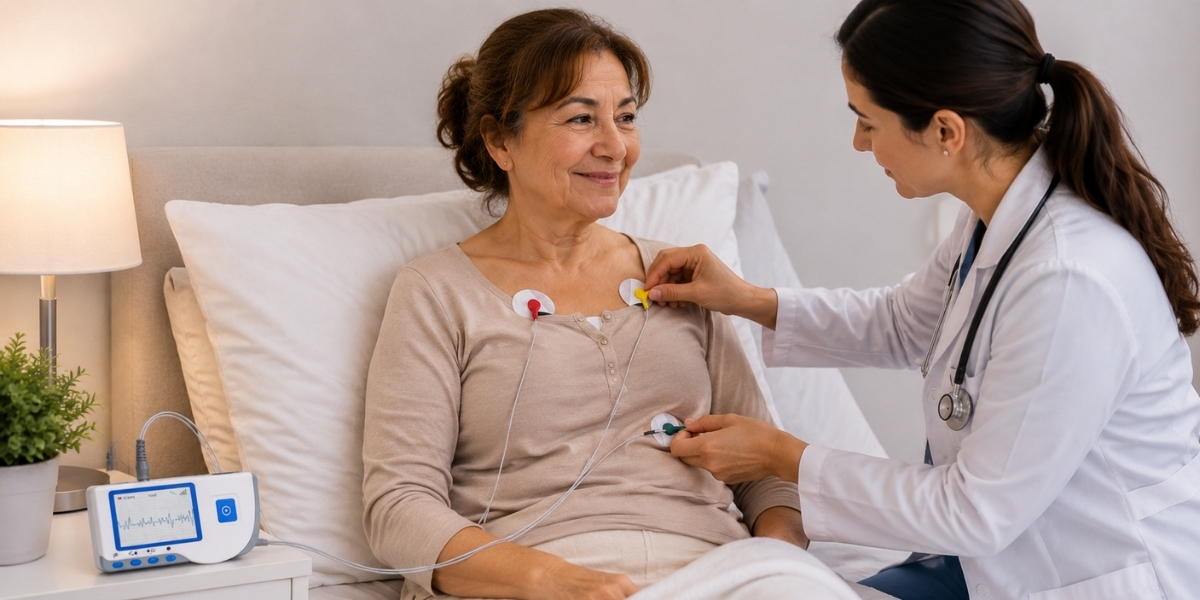
Small adhesive electrodes are placed on your chest and connected to a lightweight recorder that you carry in a pouch or clipped to your clothing. Because it captures hours of continuous data rather than seconds, a Holter monitor dramatically increases the chance of catching intermittent rhythm problems that a brief test would miss.
You can learn more about the broader range of heart rhythm and monitoring tests available on the BK Heart diagnostic services page.
Your GP or cardiologist may suggest Holter monitoring if you experience symptoms that could be related to your heart rhythm. Common reasons include:
According to healthdirect, Australia’s government-funded health information service, a Holter monitor is a common and safe way to investigate irregular heartbeats and related symptoms. It’s non-invasive, painless, and carries no radiation.
Importantly, an unusual sensation doesn’t always mean something is seriously wrong with your heart. Many palpitations are harmless. The purpose of monitoring is to gather objective information so your cardiologist can tell the difference between a benign rhythm and one that needs treatment and to give you reassurance either way.
One of the most common questions people have is simply: what’s it like to wear one? The process is straightforward.
Fitting the device. At your appointment, a clinician cleans and prepares small areas of skin on your chest and attaches the electrodes. These connect to the recorder, which is about the size of a small mobile phone. The whole fitting usually takes only a short time.
Going about your day. This is the key part of continuing your normal routine. You can go to work, do household tasks, walk around Wynnum or Capalaba, and sleep as usual. The more “normal” your day, the more useful the recording, because the goal is to capture your heart doing what it ordinarily does.
Keeping a symptom diary. You’ll usually be asked to note the time whenever you feel a symptom, a flutter, dizziness, or anything unusual along with what you were doing. This lets your cardiologist line up your symptoms with the exact heart activity recorded at that moment, which is one of the most valuable parts of the test.
A few practical points. The recorder generally shouldn’t get wet, so you’ll be advised about showering. You’ll also avoid heavy sweating where possible, as it can loosen the electrodes. Otherwise, there are very few restrictions.
After the monitoring period, you return the device, and the recorded data is downloaded for analysis.
The recording from a Holter monitor contains a huge amount of data every single heartbeat over the monitoring period. This is reviewed and interpreted by a cardiologist, who looks for abnormal rhythms, pauses, fast or slow heart rates, and whether any of these line up with the symptoms you noted in your diary.
At BK Heart, recordings are carefully reviewed by Dr Neelabh Sharma, a consultant cardiologist (MBBS, FRACP) whose clinical interests include rhythm disturbances and the assessment of palpitations and related symptoms. The findings are then discussed with you in a consultation, where what the results mean for your care is explained clearly. Depending on what’s found, the next steps might include reassurance, adjustment of medications, further testing such as extended monitoring, or referral for specific treatments.
This combination of detailed data and specialist interpretation is what turns a day of recording into clear, actionable guidance about your heart.
Sometimes symptoms are so infrequent that even a 24- or 48-hour recording doesn’t capture them. In these cases, your cardiologist may recommend extended cardiac monitoring over a longer period. BK Heart offers extended monitoring options as part of its diagnostic services, so that even infrequent rhythm events have a better chance of being recorded. Your cardiologist will advise which type and duration of monitoring is most appropriate for your situation, convenient for patients across Lota, Manly West, Hemmant, Murarrie, Wakerley, Gumdale, Cleveland and Thornlands.
If you’ve been experiencing palpitations, dizziness, or other symptoms that might be linked to your heart rhythm, a Holter monitor can help provide answers. BK Heart in Alexandra Hills offers Holter and extended cardiac monitoring for patients across Brisbane’s bayside and eastern suburbs, with specialist interpretation and a clear explanation of what the results mean for you.
Talk to your GP about a referral, then contact our team to arrange your appointment.
BK Heart — The Specialist Cardiac Centre
Shop 38/71 Cambridge Drive, Alexandra Hills, QLD 4161
Phone: (07) 3733 1536 · Email: info@bkheart.com.au
Monday to Friday, 8:30 AM – 4:30 PM